Small jewelry casting machines may look compact, but they encapsulate a remarkably refined process that transforms fragile wax models into durable metal pieces with high precision. Understanding this workflow not only improves results but also helps avoid common defects that often frustrate beginners.
The process begins with wax modeling. Whether hand-carved or produced through injection into silicone molds, wax patterns define every detail of the final piece. At this stage, surface quality is critical—any imperfection in wax will be faithfully reproduced in metal. Skilled jewelers often spend more time refining wax than casting itself.
Once the models are ready, they are attached to a central wax sprue, forming what is commonly called a “tree.” The design of this sprue system is not arbitrary. Proper flow channels ensure that molten metal fills each cavity evenly, while also allowing gases to escape. Poor sprue design is one of the leading causes of incomplete casts and porosity.
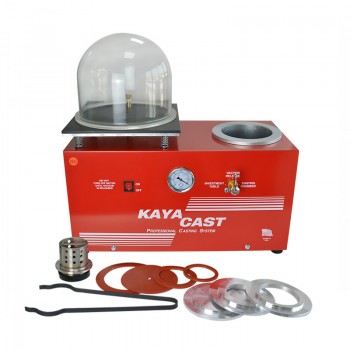
The assembled tree is then placed in a casting flask and surrounded with investment material, typically a gypsum-based compound. After mixing under vacuum to eliminate air bubbles, the investment hardens around the wax structure. The next phase, burnout, is where transformation truly begins. The flask is gradually heated in a kiln, allowing the wax to melt and burn away, leaving behind a precise cavity in the hardened mold.
Temperature control during burnout is crucial. Too rapid heating can crack the investment, while insufficient burnout leaves residue that contaminates the metal. Experienced operators often follow a staged heating schedule to ensure complete wax removal and proper mold strength.
Once burnout is complete, the flask is transferred—still hot—to the casting machine. Small jewelry casting machines typically use centrifugal force or vacuum assistance. In centrifugal systems, molten metal is flung into the mold by rotational force. Vacuum systems, on the other hand, draw metal into the cavities while simultaneously removing trapped air. Each method has its advantages: centrifugal casting excels in filling fine, while vacuum casting offers better control and reduced turbulence.
Melting the metal itself requires attention to alloy composition and temperature. Overheating can lead to oxidation and gas absorption, while underheating risks incomplete filling. Modern benchtop machines often integrate precise temperature controls or pair with induction melting units to improve consistency.
After casting, the flask is quenched in water once it has cooled to an appropriate temperature. The investment breaks away, revealing the rough metal tree. From here, the process transitions into finishing—cutting, filing, polishing, and sometimes additional treatments like plating or stone setting.
What distinguishes a high-quality casting is not just the machine, but the harmony between each step. Clean wax work, intelligent sprue design, controlled burnout, and precise casting all contribute to the final result. In small-scale jewelry production, mastering this chain of processes is far more valuable than relying solely on equipment specifications.