Working with a small lapidary cabbing machine doesn’t mean you’re limited to basic shapes or beginner-level results. In fact, many skilled lapidaries achieve competition-grade stones using compact equipment—it’s all about technique, control, and understanding your machine’s capabilities. Here are some advanced cabbing techniques that can elevate your work, even on a modest setup.
1. Precision Preforming for Better Symmetry
Advanced cabbing starts long before the polishing stage. With a small cabbing machine, mastering your preform is key. Use fine, deliberate movements on the coarse wheel to achieve clean outlines and well-defined shoulders. To maintain symmetry, rotate the stone frequently and check your shape under good lighting. Don’t rush this step—any inconsistency now will multiply as you move through finer grits.
2. Dome Control Through Micro-Angling
Creating a perfectly balanced dome is one of the hallmarks of high-level cabbing. On smaller machines, where wheel width may be limited, micro-angling your stone becomes essential. Instead of holding the cab flat against the wheel, gradually raise and lower your wrist to create smooth curvature. Work from the girdle upward, overlapping each pass to eliminate flats. This technique is especially effective on compact machines where you feel the wheel feedback more directly.
3. Managing Heat on a Small Setup
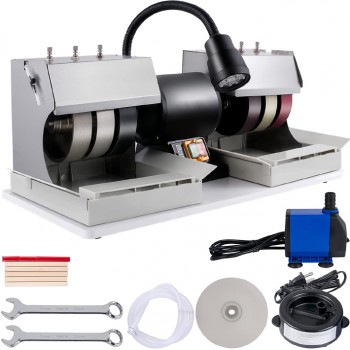
Small lapidary cabbing machines tend to generate heat faster due to narrower wheels and compact splash guards. To avoid thermal fractures—especially in stones like opal, labradorite, or fluorite—develop a rhythm of brief contact and quick dips in water. For hard stones such as agate or jasper, maintaining coolness also improves polish quality. If your machine allows, adjust water flow to provide a consistent film across the wheel.
4. Edge Refinement Using Light Touches
Refining the girdle and edge transitions is where a cab can go from “good” to “exceptional.” With a small machine, apply feather-light pressure as you refine edges on 600 and 1200 grit wheels. Small cabbing units are surprisingly responsive to pressure changes, allowing you to sculpt clean, crisp lines that don’t appear over-ground. A final pass on the pre-polish wheel, using almost no pressure, will keep edges sharp without flattening the dome.
5. Advanced Polishes with Add-On Pads
Though limited in wheel size, small machines can still achieve mirror finishes when paired with polishing pads or discs. Cerium oxide, diamond paste, or alumina compounds can be used on felt or leather pads to bring out rich luster. For stones with unique structures—like star sapphires or sunstone—switching to a resin-backed pad lets you fine-tune the angle to enhance optical effects.
6. Maximizing Output Through Workflow Efficiency
Advanced cabbing isn’t only about the stone—it’s also about how you work. Arrange your workspace so that dop wax, water, and polishing compounds are within easy reach. Because small machines operate closer to your hands, maintaining focus and consistency becomes easier when your workflow is clean and uninterrupted.
A small lapidary machine is far more capable than many assume. With refined techniques and deliberate control, you can craft beautifully domed, high-symmetry cabs that rival those made on professional-grade equipment. The machine size may be small, but your cabbing results don’t have to be.
Related articles: https://truongyen2442y.wixsite.com/jewelerstoolsmall/post/can-a-magnetic-tumbler-replace-hand-polishing