Precision is everything in jewelry making. Whether you are drilling a hole for a gemstone setting, creating a channel for a pendant, or preparing components for assembly, accuracy and control can make the difference between a flawless piece and wasted material. This is where the drill press earns its place in the jewelry workshop. Unlike handheld tools, a drill press offers stability, repeatability, and finesse—qualities that are essential when working with delicate and valuable jewelry materials.
Jewelry metals vary widely in hardness and behavior, and a jewelry making drill press adapts to these differences through speed control and tool selection. Soft metals such as gold, silver, and copper require lower drilling speeds and sharp, fine drill bits to prevent grabbing or distortion. A drill press allows the jeweler to apply consistent downward pressure, reducing the risk of bending thin sheets or warping small components. The result is cleaner holes with smoother edges, even in ultra-thin materials.
Harder metals like stainless steel, titanium, and platinum present a different challenge. These materials generate more heat and resistance during drilling. A drill press handles them more effectively by maintaining steady torque and alignment, which prevents bit breakage and uneven holes. When paired with proper lubrication and carbide or cobalt drill bits, the press can work through tough alloys without sacrificing precision or safety.
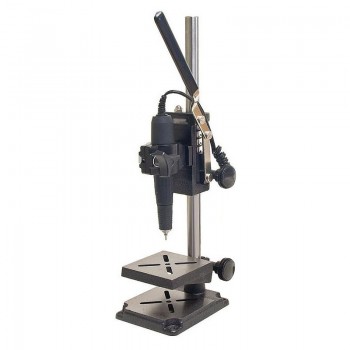
Beyond metals, drill presses are equally valuable for non-metal jewelry materials. When drilling gemstones, consistency and vibration control are critical. While specialized gemstone drilling systems are often preferred, a well-adjusted drill press equipped with diamond-coated bits can be used for softer stones and practice pieces. The vertical motion of the press minimizes lateral stress, lowering the chance of cracks or fractures. For materials like resin, acrylic, wood, or bone, adjustable speeds help prevent melting, chipping, or tear-out.
One of the key advantages of a drill press is control over depth. Jewelry components often require blind holes or exact depths for setting pins and posts. Depth stops ensure uniform results across multiple pieces, which is especially important in small production runs or matching sets. This level of repeatability is difficult to achieve with handheld drills.
Safety and ergonomics also play a role in how drill presses handle jewelry work. Secure clamping keeps tiny pieces from spinning dangerously, while both hands remain free to guide and stabilize the process. This not only improves accuracy but also reduces fatigue during detailed work sessions.
In essence, a drill press bridges the gap between raw material and refined jewelry. By offering stability, precision, and adaptability, it allows jewelers to work confidently across a wide range of materials. When used thoughtfully, the drill press becomes more than a machine—it becomes a trusted partner in transforming fragile materials into lasting, wearable art.