

Cyber ranges Market Summary
Cyber ranges are virtual environments used for cybersecurity, cyberwarfare training, simulation or emulation and development of technologies related to cybersecurity. Their scale can vary drastically, from just a single node to an internet-like network.
In recent years, the cyber range has continuously developed and evolved in terms of presentation form, application technology, construction scale, and service system to meet the security protection capacity needs of different stages. Overall, the cyber range has undergone continuous iterations, evolving from traditional physical cyber range to virtualized cyber range, large-scale virtual real combination cyber ranges, and industry-specific cyber ranges.
Source, Nightwing
According to the new market research report “Global Cyber Range Market Report 2026-2032”, published by QYResearch, the global Cyber Range market size is projected to reach USD 4.7 billion by 2032, at a CAGR of 10.3% during the forecast period.
Figure00001. Global Cyber ranges Market Size (US$ Million), 2021-2032
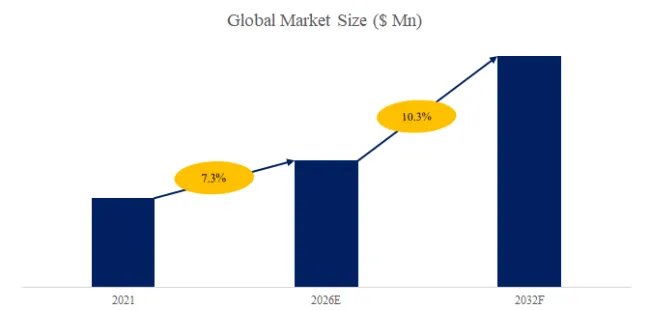
Above data is based on report from QYResearch: Global Cyber ranges Market Report 2026-2032 (published in 2026). If you need the latest data, plaese contact QYResearch.
Industry Chain Collaboration: Full-Chain Empowerment from Technological Foundation to Scenario Implementation The cyber range industry chain has formed a complete ecosystem encompassing “upstream technical support – midstream platform construction – downstream scenario applications.” Upstream focuses on breakthroughs in underlying technologies, covering core capabilities such as virtualization engines, threat intelligence databases, and AI attack and defense algorithms. For example, domestic virtualization technology, through dynamic resource scheduling and isolation mechanisms, supports the simultaneous operation of hundreds of virtual financial business nodes on a single physical server, meeting high-concurrency simulation requirements; machine learning-based threat intelligence databases can update global attack characteristics in real time, injecting “intelligent defense genes” into the range. Midstream is led by professional security vendors, who divide the range into core functional modules such as attack and defense drills, vulnerability reproduction, and emergency response through modular design, and provide customized deployment services. For example, a company’s “cloud range” solution for banks supports remote access by branches, covering more than 20 typical scenarios such as ATM attacks and mobile payment fraud. Downstream application scenarios continue to expand, extending beyond traditional financial institutions to critical infrastructure fields such as power, communications, and the industrial internet, becoming a core security infrastructure for digital transformation.
Policy-Driven: National Strategy Leads High-Quality Industry Development
The continuous release of policy dividends provides strong support for the construction of cyber ranges. At the national level, cybersecurity has been incorporated into the national security system, with the successive promulgation of regulations such as the Cybersecurity Law and the Regulations on the Security Protection of Critical Information Infrastructure, explicitly requiring key industries such as finance, energy, and transportation to conduct regular attack and defense drills. For example, the National Energy Administration has issued documents for three consecutive years to promote the construction of power network ranges, requiring power companies to conduct annual attack and defense drills through these ranges to improve emergency response capabilities. In the financial sector, regulatory agencies have incorporated range drills into compliance requirements, promoting the construction of full-scenario simulation environments by banks, securities firms, and other institutions. Under policy guidance, cyber ranges have upgraded from “optional tools” to “standard compliance equipment,” leading to explosive growth in industry demand.
Trends and Opportunities: Dual-Wheel Drive of Technological Integration and Ecosystem Collaboration
The industry is showing three major development trends: technological integration, with deep coupling of technologies such as AI, blockchain, and 5G, enhancing the intelligence level of ranges. For example, AI-driven automated attack script generation tools can simulate the stealthy characteristics of advanced persistent threats (APTs); blockchain technology is used to record drill data, ensuring the immutability of results. The scenario is becoming increasingly comprehensive, extending from traditional IT systems to new architectures such as the Internet of Things (IoT), mobile devices, and cloud-native technologies. For example, a securities firm developed an “IoT financial testbed” that can simulate the hijacking of smart investment advisory devices, enhancing IoT financial security capabilities. The ecosystem is becoming more open, integrating with third-party security tools through open API interfaces to form a closed-loop ecosystem of “testbed + threat intelligence + security operations.” On the opportunity side, emerging fields such as intelligent connected vehicles and the industrial internet have an urgent need for high-fidelity simulation environments, opening up a second growth curve for testbed vendors.
Challenges and Breakthroughs: From Single Exercises to Capability Forging
The industry faces multiple challenges: Technically, high-end testbeds rely on imported virtualization engines and attack/defense tools, with a domestic production rate of less than 40%; in terms of cost, the construction of large-scale testbeds requires an investment of over ten million yuan, which is difficult for small and medium-sized enterprises to afford; in terms of talent, there is a shortage of hundreds of thousands of compound talents who understand both business operations and are proficient in attack and defense, hindering the realization of practical effectiveness. The key to breaking the deadlock lies in differentiated competition and ecosystem co-construction: leading companies focus on full-scenario coverage, consolidating their market position through technological iteration; SMEs cultivate niche areas, such as developing lightweight test ranges for rural financial institutions, or focusing on emerging scenarios like mobile payment and digital currency; simultaneously, they strengthen cooperation with universities and research institutions to overcome key technologies such as virtualization performance bottlenecks and AI attack and defense algorithms, driving the industry to upgrade from a “single training platform” to a “financial security brain.”
Entry Barriers: A Triple Test of Technology, Capital, and Ecosystem The network test range market faces high barriers to entry: technological barriers require mastering core patents such as virtualization scheduling and attack chain modeling. For example, building a large-scale, high-fidelity test range requires integrating cutting-edge technologies from multiple fields such as virtualization, SDN, and traffic simulation; capital barriers require R&D investment in large test ranges to cover hardware equipment, software licensing, and continuous operation and maintenance costs, which is difficult for SMEs to bear; ecosystem barriers require establishing long-term cooperation with financial institutions, regulatory authorities, and security vendors to form a closed loop of “demand-R&D-feedback.” Against this backdrop, new entrants need to break through the encirclement by differentiating themselves, such as focusing on specific industry scenarios or developing open-source testbed platforms to lower the barrier to entry, in order to gain a foothold in the fierce market competition.
About The Authors
| Chengping Zhang | A experienced Technology & Market Analyst. Deep experience in chemical industry, focus on electronic materials, engineering materials and mineral resources, etc. Fully engaged in the development of technology and market reports as well as custom projects. | |
|
Senior Analyst |
||
| Email: zhangchengping@qyresearch.com |
Website: www.qyresearch.com Hot Line:4006068865
QYResearch focus on Market Survey and Research
US: +1-888-365-4458(US) +1-202-499-1434(Int’L)
EU: +44-808-111-0143(UK) +44-203-734-8135(EU)
Asia: +86-10-8294-5717(CN) +852-30628839(HK)
About QYResearch
QYResearch founded in California, USA in 2007.It is a leading global market research and consulting company. With over 17 years’ experience and professional research team in various cities over the world QY Research focuses on management consulting, database and seminar services, IPO consulting (data is widely cited in prospectuses, annual reports and presentations), industry chain research and customized research to help our clients in providing non-linear revenue model and make them successful. We are globally recognized for our expansive portfolio of services, good corporate citizenship, and our strong commitment to sustainability. Up to now, we have cooperated with more than 60,000 clients across five continents. Let’s work closely with you and build a bold and better future.
QYResearch is a world-renowned large-scale consulting company. The industry covers various high-tech industry chain market segments, spanning the semiconductor industry chain (semiconductor equipment and parts, semiconductor materials, ICs, Foundry, packaging and testing, discrete devices, sensors, optoelectronic devices), photovoltaic industry chain (equipment, cells, modules, auxiliary material brackets, inverters, power station terminals), new energy automobile industry chain (batteries and materials, auto parts, batteries, motors, electronic control, automotive semiconductors, etc.), communication industry chain (communication system equipment, terminal equipment, electronic components, RF front-end, optical modules, 4G/5G/6G, broadband, IoT, digital economy, AI), advanced materials industry Chain (metal materials, polymer materials, ceramic materials, nano materials, etc.), machinery manufacturing industry chain (CNC machine tools, construction machinery, electrical machinery, 3C automation, industrial robots, lasers, industrial control, drones), food, beverages and pharmaceuticals, medical equipment, agriculture, etc.
About Us:
QYResearch founded in California, USA in 2007, which is a leading global market research and consulting company. Our primary business include market research reports, custom reports, commissioned research, IPO consultancy, business plans, etc. With over 18 years of experience and a dedicated research team, we are well placed to provide useful information and data for your business, and we have established offices in 7 countries (include United States, Germany, Switzerland, Japan, Korea, China and India) and business partners in over 30 countries. We have provided industrial information services to more than 60,000 companies in over the world.
Contact Us:
If you have any queries regarding this report or if you would like further information, please contact us:
QY Research Inc.
Add: 17890 Castleton Street Suite 369 City of Industry CA 91748 United States
EN: https://www.qyresearch.com
Email: global@qyresearch.com
Tel: 001-626-842-1666(US)
JP: https://www.qyresearch.co.jp










