

Indoor Smart Security Camera Market Summary
The global Indoor Smart Security Camera market size is estimated to reach US$ 13928.3 million by 2026 and is anticipated to reach US$ 26908.1 million by 2032, witnessing a CAGR of 11.60% during the forecast period 2026-2032.
Figure00001. Global Indoor Smart Security Camera Market Size (US$ Million), 2021-2032
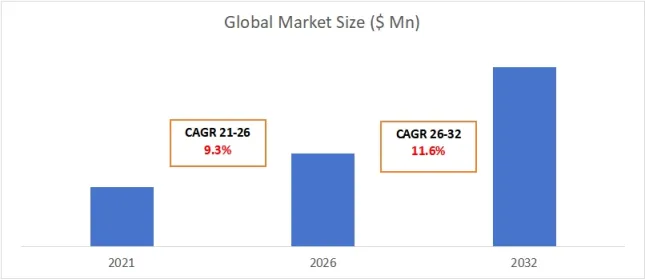
Above data is based on report from QYResearch: Global Indoor Smart Security Camera Market Report 2025-2031 (published in 2025). If you need the latest data, please contact QYResearch.
In 2025, the global top 10 players revenue share was approximately 78%.
Figure00002. Global Indoor Smart Security Camera Top 10 Players Ranking and Market Share
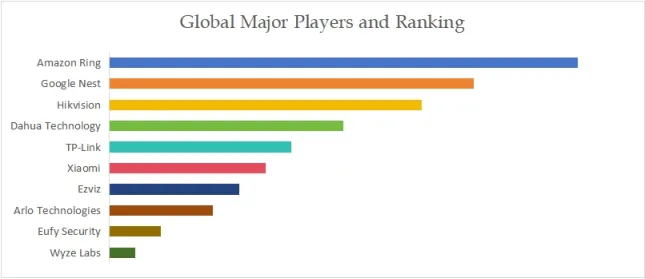
Above data is based on report from QYResearch: Global Indoor Smart Security Camera Market Report 2025-2031 (published in 2025). If you need the latest data, plaese contact QYResearch.
Competitive Landscape
The market is led by ecosystem-driven consumer brands and large-scale video surveillance vendors. Amazon Ring and Google Nest leverage platform integration and subscription services, while Hikvision and Dahua Technology bring scale and hardware depth from professional security. Networking and value-focused brands such as TP-Link, Xiaomi, and Ezviz compete on price-performance and distribution, while Arlo Technologies, Eufy Security, and Wyze Labs differentiate via features, privacy positioning, or aggressive pricing. Competition increasingly centers on AI accuracy, app experience, privacy options, and service ecosystems rather than hardware specs alone.
Main Type
By connectivity and power, products are commonly segmented into Wi-Fi Smart Security Cameras, Wired Smart Security Cameras, and Cellular Smart Security Cameras. Wi-Fi models dominate due to easy setup and lower total cost. Wired cameras emphasize stability and continuous recording for fixed installations. Cellular cameras address locations without reliable broadband but carry higher operating costs and are less common indoors.
Downstream Applications
Usage splits between Home Use and Commercial Use. Home applications drive volume, focusing on simplicity, AI alerts, and privacy controls for apartments and houses. Commercial indoor deployments (small offices, retail, hospitality) prioritize reliability, multi-device management, and evidence-grade recording, often with centralized administration.
Regional Perspective
North America leads adoption with strong smart-home penetration and subscription-based services. Europe emphasizes privacy, data protection, and compliance, shaping feature sets and storage choices. Asia Pacific combines high volume and fast innovation cycles, with strong price competition and rapid AI feature rollout. Latin America grows with affordability-led demand and channel expansion. Middle East & Africa remains smaller but project-driven, favoring dependable hardware and local support.
Price Analysis
Pricing spans entry-level to premium tiers, driven by resolution, AI features, cloud services, privacy options, and ecosystem integration. Entry models compete on affordability, while mid-to-high tiers command premiums for advanced analytics, better low-light performance, and polished software. Buyers increasingly evaluate total cost of ownership, including subscriptions and storage.
Market Drivers
One of the primary market drivers is the rising demand for continuous, remote visibility of indoor spaces, fueled by lifestyle changes such as remote work, increased mobility, and growing attention to home and small-business security. Indoor cameras are increasingly seen not only as security devices but also as tools for monitoring family members, pets, and property, expanding their addressable use cases.
Technological progress—particularly the deployment of edge AI—is another major catalyst. Improved on-device processing reduces reliance on cloud resources, lowers latency, enhances privacy, and improves detection accuracy. This makes smart cameras more acceptable to privacy-conscious users and enables broader adoption across regions with different regulatory environments.
The expansion of smart home ecosystems further accelerates demand. Indoor cameras often serve as a central sensing node that integrates with locks, alarms, lighting, and voice assistants, increasing their functional value within connected environments. Ecosystem integration encourages multi-device adoption and replacement upgrades as users deepen their investment in a single platform.
About The Authors
Yang Huchen | Industry Researcher
Personal Profile
With six years of experience in equipment industry research and consulting, I have consistently tracked the development of mechanical equipment and industrial technology both domestically and internationally, accumulating extensive experience in industry research, data analysis, and market forecasting. I possess a solid foundation in industry trend insights, corporate strategy analysis, market sizing, and competitive landscape research, enabling me to provide clients with forward-looking and actionable research results.
Research Areas
Mechanical Equipment: Including port machinery, special equipment, and engineering equipment.
Industrial Automation: Covering intelligent manufacturing, robotics, sensing and control systems.
Construction Machinery: Key areas such as cranes, excavators, and concrete machinery.
Frontier Equipment: High-tech cryo-electron microscopes, laser weapons, and other cutting-edge technologies.
Project Experience
Led and participated in numerous key research and consulting projects, including:
Mobile Port Cranes: Analyzing global and Chinese market supply and demand patterns, price trends, and technology roadmaps, producing industry benchmark reports.
Cryo-electron microscopes: Analyzing the competitive landscape of core suppliers within the industry chain and the prospects for cutting-edge applications, providing guidance to scientific research institutions. Providing decision support to institutions and enterprises.
Laser Weapon Systems: Tracks emerging equipment markets in the military industry, analyzing the policy environment, technological evolution paths, and application potential.
Engineering Machinery Industry Research Series: Covers equipment such as excavators and loaders, builds competitiveness models, and provides development recommendations.
Partner Clients
Clients include top international manufacturers and leading domestic manufacturers, including:
Toshiba、Honda、Caterpillar、Hitachi、etc.
In addition, we provide research and strategic consulting services to some leading domestic equipment companies and emerging manufacturing companies in China.
Personal Strengths
Systematic Research Ability: Specializes in comprehensive industry chain analysis, with in-depth research experience from upstream components to downstream application scenarios.
Interdisciplinary Perspective: Able to establish research connections between traditional machinery and emerging high-end equipment.
Data-Driven: Proficient in market sizing, price modeling, and trend forecasting.
International Background: Experienced in multinational corporate research, with a deep understanding of international market dynamics and local market differences.
Contact Information
Email: yanghuchen@qyresearch.com
Tel: +86-17801072109
About QYResearch
https://www.qyresearch.com
QYResearch founded in California, USA in 2007.It is a leading global market research and consulting company. With over 17 years’ experience and professional research team in various cities over the world QY Research focuses on management consulting, database and seminar services, IPO consulting, industry chain research and customized research to help our clients in providing non-linear revenue model and make them successful. We are globally recognized for our expansive portfolio of services, good corporate citizenship, and our strong commitment to sustainability. Up to now, we have cooperated with more than 60,000 clients across five continents. Let’s work closely with you and build a bold and better future.
QYResearch is a world-renowned large-scale consulting company. The industry covers various high-tech industry chain market segments, spanning the semiconductor industry chain (semiconductor equipment and parts, semiconductor materials, ICs, Foundry, packaging and testing, discrete devices, sensors, optoelectronic devices), photovoltaic industry chain (equipment, cells, modules, auxiliary material brackets, inverters, power station terminals), new energy automobile industry chain (batteries and materials, auto parts, batteries, motors, electronic control, automotive semiconductors, etc.), communication industry chain (communication system equipment, terminal equipment, electronic components, RF front-end, optical modules, 4G/5G/6G, broadband, IoT, digital economy, AI), advanced materials industry Chain (metal materials, polymer materials, ceramic materials, nano materials, etc.), machinery manufacturing industry chain (CNC machine tools, construction machinery, electrical machinery, 3C automation, industrial robots, lasers, industrial control, drones), food, beverages and pharmaceuticals, medical equipment, agriculture, etc.
About Us:
QYResearch founded in California, USA in 2007, which is a leading global market research and consulting company. Our primary business include market research reports, custom reports, commissioned research, IPO consultancy, business plans, etc. With over 18 years of experience and a dedicated research team, we are well placed to provide useful information and data for your business, and we have established offices in 7 countries (include United States, Germany, Switzerland, Japan, Korea, China and India) and business partners in over 30 countries. We have provided industrial information services to more than 60,000 companies in over the world.
Contact Us:
If you have any queries regarding this report or if you would like further information, please contact us:
QY Research Inc.
Add: 17890 Castleton Street Suite 369 City of Industry CA 91748 United States
EN: https://www.qyresearch.com
Email: global@qyresearch.com
Tel: 001-626-842-1666(US)
JP: https://www.qyresearch.co.jp










