

QY Research Inc. (Global Market Report Research Publisher) announces the release of 2025 latest report “Ion Laser- Global Market Share and Ranking, Overall Sales and Demand Forecast 2026-2032”. Based on current situation and impact historical analysis (2020-2024) and forecast calculations (2026-2032), this report provides a comprehensive analysis of the global Ion Laser market, including market size, share, demand, industry development status, and forecasts for the next few years.
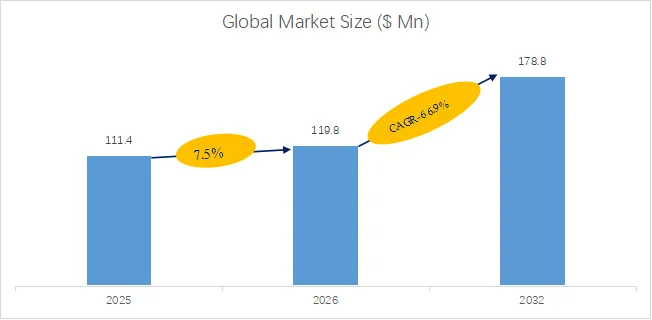
The global market for Ion Laser was estimated to be worth US$ 111 million in 2025 and is projected to reach US$ 179 million, growing at a CAGR of 6.9% from 2026 to 2032.
【Get a free sample PDF of this report (Including Full TOC, List of Tables & Figures, Chart)】
https://www.qyresearch.com/reports/5737593/ion-laser
Ion Laser Market Overview: Rebuilding Sweetness in the Reduced-Sugar Era
Product Definition
An ion laser is a type of gas laser that uses positively charged ions as the gain medium, typically generated and excited inside the cavity by an intense electric arc discharge. In practical terms, the best-known commercial examples are argon-ion and krypton-ion lasers. Historically, this technology became especially important after William B. Bridges discovered and patented the noble-gas ion laser in 1964, establishing ion lasers as one of the defining continuous-wave visible laser technologies of the classical laser era.
Product Image of a Ion Laser
Technology
Ion lasers remained important for so long because they combine continuous-wave operation, very good beam quality, and a broad selection of output wavelengths. Argon-ion lasers commonly operate at lines such as 488.0 nm, 514.5 nm, 457.9 nm, 496.5 nm, and 501.7 nm, covering blue, blue-green, green, and parts of the near-UV region. Krypton-ion lasers add visible colors that argon does not provide so easily, including the well-known 647.1 nm red line and 568.2 nm yellow line, along with other green and blue-violet outputs. For systems that depend on specific excitation wavelengths, this combination of spectral flexibility and stable continuous output made ion lasers exceptionally valuable.
Application
Their importance has always been tied to application quality rather than simple light generation. Ion lasers were widely used in confocal microscopy, Raman spectroscopy, holography, wafer inspection, certain lithography and mastering processes, laser printing, laser light shows, and as pump sources for titanium-sapphire and dye lasers. In medicine, argon-ion lasers were also used in retinal photocoagulation and related ophthalmic procedures. In microscopy, argon-ion and krypton-ion sources were long regarded as standard excitation tools because they provided suitable laser lines for fluorescence work together with strong beam geometry and stable performance.
At the same time, the weaknesses of ion lasers are just as characteristic as their strengths. Maintaining the required ionization and excitation conditions demands high-current discharge and substantial electrical input. High-power argon-ion systems producing multi-watt continuous output often consume several kilowatts or more of electrical power, so wall-plug efficiency is typically far below 1%, and often below 0.1% in large systems. They also generate significant heat, which is why most units require water cooling. In addition, the laser tube is a wear component, and harsh plasma conditions limit tube life to only a few thousand hours in many cases, making maintenance, cooling, and operating costs relatively high.
For that reason, ion lasers have shifted from mainstream general-purpose sources to a more specialized role centered on legacy systems and applications needing specific wavelengths. As laser diodes, DPSS lasers, and OPSLs matured, many applications once dominated by ion lasers—especially in microscopy, life science instrumentation, inspection, and parts of medical and semiconductor work—moved toward smaller, more efficient, longer-lived solid-state alternatives. Even so, ion lasers have not disappeared. They still retain value where particular visible or ultraviolet lines are needed, where installed systems are built around those wavelengths, or where users continue to rely on the distinctive operating characteristics of mature ion-laser platforms. Their position today is no longer that of a universal workhorse, but of a classic technology that still matters in selected high-specificity use cases.
Multidimensional Classification and Parameters
|
Classification Dimension |
Sub-Type |
Key Specification Range |
Technical Characteristics |
|
By Gain Medium |
Argon Ion Laser (Ar⁺) | Wavelength 488 nm / 514.5 nm; Power 10 mW–20 W | Blue-green visible output |
| Krypton Ion Laser (Kr⁺) | Wavelength 568 nm / 647 nm; Power 10 mW–10 W | Red output | |
| Mixed-Gas Ion Laser | Multi-line output | Switchable wavelengths | |
|
By Output Mode |
Continuous Wave (CW) | Stable output 10 mW–50 W | Mainstream operation |
| Pulsed Mode | Pulse width µs–ms | Special research use | |
|
By Power Rating |
Low Power | <1 W | Desktop lab systems |
| Medium Power | 1–10 W | Standard research | |
| High Power | >10 W | Industrial-grade | |
|
By Cooling Method |
Air-Cooled | <5 W | Simple design |
| Water-Cooled | >5 W | High thermal efficiency | |
|
By Structural Type |
External Cavity | Cavity length 30–100 cm | Stable beam output |
| Integrated Cavity | Compact configuration | Easy integration | |
|
Key Performance Parameters |
— | Operating current 10–40 A | High-current discharge |
| — | Operating voltage 100–300 V | High-power supply | |
| — | Beam quality M² <1.3 | Gaussian beam | |
| — | Electro-optical efficiency 0.1%–0.5% | Low efficiency | |
| — | Lifetime 1,000–5,000 hours | Electrode wear dependent |
Market Size
According to research by the QYResearch, the Ion Laser market size reached US$111.4 million in 2025 and is expected to reach US$119.8 million in 2026, with a CAGR-6 of 6.9% in the next six years.
Global Ion Lasers Market Size
Ion Lasers Industry Chain, Industry Policies, Development Trends and Barriers to Entry
Industrial Chain
Ion lasers are gas lasers that generate stimulated emission by electrically exciting ionized gas atoms. The upstream segment primarily includes high-purity gas materials, precision vacuum chamber components, optical elements such as mirrors and windows, high-voltage power supply modules, cooling systems, and reliable electronic control systems. The purity of inert gases and the stability of high-voltage power supplies are fundamental to output consistency, while high-quality optical components directly influence beam quality and operational lifespan. The precision and reliability of upstream components significantly determine overall system performance.
On the downstream side, research institutions and universities represent major application markets. Ion lasers provide stable continuous-wave output and high beam quality, making them suitable for spectroscopy, atomic physics experiments, Raman analysis, and advanced material research. Research users prioritize wavelength stability, output consistency, and long-term operational reliability. As quantum technologies and precision measurement applications expand, demand for highly stable light sources continues in certain niches.
The medical sector is another important downstream market. Ion lasers have historically been used in ophthalmology, dermatology, and specialized surgical procedures where specific wavelengths and stable continuous output are required. Medical users emphasize regulatory certification, operational safety, and maintenance efficiency. Although some applications have shifted toward solid-state laser technologies, ion lasers still retain relevance in certain specialized medical segments.
Industrial manufacturing also forms part of the downstream landscape. Ion lasers are utilized in precision processing, photolithography, semiconductor inspection, and high-resolution imaging. Industrial customers focus on power stability, system integration capability, and compatibility with automated production environments. In high-end semiconductor inspection and microfabrication applications, specific ion laser wavelengths continue to offer technical advantages.
Industry Policies
From a regulatory perspective, ion lasers must comply with laser safety classifications, electromagnetic compatibility requirements, and industrial equipment standards. Medical-use systems require medical device certification in relevant jurisdictions. In some regions, export controls may apply to advanced laser technologies. Increasing environmental and energy efficiency regulations are also influencing system design considerations.
Development Trends
In terms of development trends, ion lasers face competitive pressure from solid-state and semiconductor laser technologies, which offer advantages in size, energy efficiency, and maintenance cost. Consequently, certain traditional applications are gradually transitioning to alternative laser technologies. However, in scenarios demanding exceptionally high beam quality and stable continuous output, ion lasers retain technical value. Future development directions include improving electrical-to-optical efficiency, optimizing cooling systems, and enhancing system integration.
Growth opportunities lie in high-end research equipment upgrades, expansion of precision measurement technologies, and stable demand in specialized medical niches. At the same time, challenges include large system size, high energy consumption, complex maintenance requirements, and relatively limited market scale. The customer base is concentrated, leading to a specialized competitive landscape.
The report provides a detailed analysis of the market size, growth potential, and key trends for each segment. Through detailed analysis, industry players can identify profit opportunities, develop strategies for specific customer segments, and allocate resources effectively.
The Ion Laser market is segmented as below:
By Company
Coherent
Lumentum
National Laser
Modu-Laser
LASOS
Sacher Lasertechnik
Newport MKS
DongWoo Optron
Hangzhou Lambda Photonics
Segment by Type
Argon Ion Laser
Krypton Ion Laser
Argon-Krypton Mixed Ion Laser
Helium-Cadmium Ion Laser
Neon Ion Laser
Segment by Application
Biomedicine
Research and Analysis
Industrial and Microelectronics
Other
Each chapter of the report provides detailed information for readers to further understand the Ion Laser market:
Chapter 1: Introduces the report scope of the Ion Laser report, global total market size (valve, volume and price). This chapter also provides the market dynamics, latest developments of the market, the driving factors and restrictive factors of the market, the challenges and risks faced by manufacturers in the industry, and the analysis of relevant policies in the industry. (2021-2032)
Chapter 2: Detailed analysis of Ion Laser manufacturers competitive landscape, price, sales and revenue market share, latest development plan, merger, and acquisition information, etc. (2021-2026)
Chapter 3: Provides the analysis of various Ion Laser market segments by Type, covering the market size and development potential of each market segment, to help readers find the blue ocean market in different market segments. (2021-2032)
Chapter 4: Provides the analysis of various market segments by Application, covering the market size and development potential of each market segment, to help readers find the blue ocean market in different downstream markets.(2021-2032)
Chapter 5: Sales, revenue of Ion Laser in regional level. It provides a quantitative analysis of the market size and development potential of each region and introduces the market development, future development prospects, market space, and market size of each country in the world..(2021-2032)
Chapter 6: Sales, revenue of Ion Laser in country level. It provides sigmate data by Type, and by Application for each country/region.(2021-2032)
Chapter 7: Provides profiles of key players, introducing the basic situation of the main companies in the market in detail, including product sales, revenue, price, gross margin, product introduction, recent development, etc. (2021-2026)
Chapter 8: Analysis of industrial chain, including the upstream and downstream of the industry.
Chapter 9: Conclusion.
Benefits of purchasing QYResearch report:
Competitive Analysis: QYResearch provides in-depth Ion Laser competitive analysis, including information on key company profiles, new entrants, acquisitions, mergers, large market shear, opportunities, and challenges. These analyses provide clients with a comprehensive understanding of market conditions and competitive dynamics, enabling them to develop effective market strategies and maintain their competitive edge.
Industry Analysis: QYResearch provides Ion Laser comprehensive industry data and trend analysis, including raw material analysis, market application analysis, product type analysis, market demand analysis, market supply analysis, downstream market analysis, and supply chain analysis.
and trend analysis. These analyses help clients understand the direction of industry development and make informed business decisions.
Market Size: QYResearch provides Ion Laser market size analysis, including capacity, production, sales, production value, price, cost, and profit analysis. This data helps clients understand market size and development potential, and is an important reference for business development.
Other relevant reports of QYResearch:
Global Ion Laser Market Outlook, In‑Depth Analysis & Forecast to 2032
Global Ion Laser Sales Market Report, Competitive Analysis and Regional Opportunities 2026-2032
Global Ion Laser Market Research Report 2026
Global Argon Ion Lasers Market Research Report 2026
Global Ion Laser Cathodes Market Research Report 2026
Ion Laser Cathodes- Global Market Share and Ranking, Overall Sales and Demand Forecast 2026-2032
Air-Cooled Argon-Ion Laser- Global Market Share and Ranking, Overall Sales and Demand Forecast 2026-2032
Global Air-Cooled Argon-Ion Laser Market Research Report 2026
Self-Contained Argon-Ion Laser- Global Market Share and Ranking, Overall Sales and Demand Forecast 2026-2032
Global Self-Contained Argon-Ion Laser Market Research Report 2026
About Us:
QYResearch founded in California, USA in 2007, which is a leading global market research and consulting company. Our primary business include market research reports, custom reports, commissioned research, IPO consultancy, business plans, etc. With over 19 years of experience and a dedicated research team, we are well placed to provide useful information and data for your business, and we have established offices in 7 countries (include United States, Germany, Switzerland, Japan, Korea, China and India) and business partners in over 30 countries. We have provided industrial information services to more than 60,000 companies in over the world.
Contact Us:
If you have any queries regarding this report or if you would like further information, please contact us:
QY Research Inc.
Add: 17890 Castleton Street Suite 369 City of Industry CA 91748 United States
EN: https://www.qyresearch.com
Email: global@qyresearch.com
Tel: 001-626-842-1666(US)
JP: https://www.qyresearch.co.jp










