

QY Research Inc. (Global Market Report Research Publisher) announces the release of 2025 latest report “Damping Alloy- Global Market Share and Ranking, Overall Sales and Demand Forecast 2026-2032”. Based on current situation and impact historical analysis (2020-2024) and forecast calculations (2026-2032), this report provides a comprehensive analysis of the global Damping Alloy market, including market size, share, demand, industry development status, and forecasts for the next few years.
The global market for Damping Alloy was estimated to be worth US$ 1106 million in 2025 and is projected to reach US$ 1942 million, growing at a CAGR of 8.5% from 2026 to 2032.
【Get a free sample PDF of this report (Including Full TOC, List of Tables & Figures, Chart)】
https://www.qyresearch.com/reports/5744779/damping-alloy
Damping alloys are a class of functional metallic materials characterized by a high capacity for internal friction; they are capable of converting mechanical vibration energy into thermal energy, thereby achieving vibration reduction, noise suppression, shock absorption, and enhanced structural stability. Fundamentally, they are not single-component materials, but rather a category of “structure-function integrated” materials resulting from the synergistic interplay of specific alloy systems, microstructural engineering, and heat treatment processes. Typical technical approaches encompass Mn-Cu-based, Fe-based, Mg-based, and TiNi-based alloys, as well as other specialized damping alloys. Among these, Mn-Cu-based alloys emphasize high internal friction driven by the motion of twin boundaries and phase interfaces; Fe-based alloys rely primarily on the movement of magnetic domain walls and energy dissipation via structural defects; Mg-based alloys achieve high specific damping through friction involving dislocations, twins, and grain boundaries; and TiNi-based alloys realize their damping function through stress-induced martensitic phase transformations and phase boundary migration, while also exhibiting shape memory and superelastic properties. Damping alloys are typically supplied in forms such as plates/strips, rods, wires, tubes, and precision components. They primarily serve sectors with stringent requirements for vibration control, noise suppression, and reliability—including automotive and rail transport, aerospace, industrial machinery, consumer electronics, precision instrumentation, energy and power systems, civil engineering, defense and military industries, and medical equipment.
Damping alloys constitute a technology-driven niche within the advanced metallic materials sector. While the overall market volume does not reach the scale of bulk commodities, their strategic value is steadily rising within high-end equipment, rail transport, aerospace, precision machinery, and low-noise structural components. According to market tracking data, the global damping alloy market is estimated to reach approximately $1 billion by 2025. By 2032, this figure is projected to approach the $1.8–$1.9 billion range, representing a compound annual growth rate (CAGR) of roughly 9% over this period—a growth trajectory that significantly outpaces that of most traditional metallic materials. The industry is currently in a transitional phase, upgrading from “general structural vibration damping” to “high-performance, customized, and multifunctional materials.” Growth is primarily driven by three factors: first, heightened requirements regarding NVH control, fatigue life, and structural stability across transportation equipment, aerospace, precision instrumentation, and industrial machinery sectors; second, rising demand for high-specific-damping or functional materials—such as Mg-based and TiNi-based alloys—fueled by the growth of new energy vehicles, lightweight equipment, and high-end manufacturing; and third, increasingly stringent demands from end-users regarding material batch consistency, in-service reliability, and application validation cycles, which are prompting the industry to expand beyond mere material sales into a comprehensive model encompassing “material design + process control + application validation.” Overall, while damping alloys remain a niche and specialized segment of the materials market, their growth quality and technical barriers are significantly higher than those of general structural alloys.
In terms of product segmentation, damping alloys can be categorized based on material system, product form, manufacturing process, and functional attributes. Regarding material systems, Mn-Cu-based and Fe-based alloys remain relatively mature solutions for structural vibration damping. These are suitable for industrial equipment, rail transit systems, specific structural components, and general mechanical vibration-damping applications; their key advantages lie in their high process maturity, controllable costs, and superior stability. Mg-based damping alloys, benefiting from the broader trend toward lightweighting, are particularly well-suited for applications requiring a simultaneous balance of weight reduction, specific damping capacity, and vibration control. TiNi-based damping alloys—distinguished by their unique combination of damping, shape memory, and superelastic properties—tend to be favored for use in medical devices, aerospace systems, precision actuators, and high-value-added functional components. In terms of product form, sheets/strips and rods are primarily utilized for structural and machined components, while wires and tubes are typically reserved for specific functional parts; precision components, meanwhile, represent a segment with higher added value. Future growth within the sector is expected to be concentrated in lightweight Mg-based alloys, high-performance TiNi-based alloys, precision-machined components, and customized damping materials tailored to specific operating conditions; conversely, the growth of general-purpose, low-value-added materials is projected to remain relatively steady, albeit accompanied by more intense price competition. Regarding underlying mechanisms, industry experts note that Mn-Cu alloys are representative examples of “twinning-type” damping alloys, whereas the damping mechanism of Mg alloys is closely intertwined with microstructural factors such as dislocations, twinning, and grain boundaries.
From the perspective of application structure, the demand for damping alloys is not driven by a single industry, but rather by the collective requirements of various high-end equipment sectors regarding “vibration, noise, shock, fatigue resistance, lightweighting, and stability.” The automotive and rail transit sectors prioritize structural vibration damping, vehicle body stability, component fatigue life, and NVH (Noise, Vibration, and Harshness) improvements. The aerospace sector focuses on lightweighting, high reliability, and vibration suppression under complex operating conditions. The industrial machinery and precision instrumentation sectors emphasize equipment operational stability, machining precision, and the maintenance of low-noise environments. Meanwhile, the energy, power, construction engineering, and bridge infrastructure sectors place greater emphasis on long-term service durability, structural safety, and vibration risk management. Finally, sectors such as medical devices and defense/military industries impose particularly stringent requirements regarding TiNi-based functional materials, precision components, and reliability verification. The core of future application growth lies not merely in the simple substitution of traditional materials, but rather in the proactive integration of damping materials into high-end equipment during the design phase—aimed at enhancing system reliability, reducing maintenance costs, and improving user experience. Overall, industrial machinery, transportation, and precision equipment remain the foundational pillars of application; meanwhile, aerospace, medical devices, new energy equipment, and high-end consumer electronics are poised to become the key growth sectors with higher added value in the medium to long term.
The global damping alloy industry is characterized by a competitive landscape defined by “stratified material pathways, reinforced process barriers, increasing concentration in the high-end market, and relative fragmentation in the mid-to-low-end markets.” Competition in the high-end market centers not on a single alloy grade, but on a comprehensive contest of capabilities encompassing material formulation design, melting purity, microstructure control, heat treatment regimens, rolling and forging processes, performance testing, fatigue reliability, and customer validation support. Mn-Cu-based and Fe-based alloys demonstrate strong applicability in structural vibration damping and industrial settings, with competition in these areas focusing primarily on performance stability, cost control, and mass supply capabilities. Mg-based alloys are more heavily influenced by the trend toward lightweighting, placing the competitive emphasis on balancing both mechanical strength and damping properties. The TiNi-based alloy pathway involves the regulation of phase transitions, high-precision processing, and functional reliability; consequently, it presents higher technical barriers and yields products with a distinctly higher added value. On the procurement side, the criteria for evaluating suppliers are expanding beyond mere “material performance parameters” to encompass “material design capabilities, process stability, quality assurance systems, application validation experience, delivery lead times, and cost control proficiency.” Therefore, companies capable of consistently delivering stable batch quality, customized development capabilities, and end-application validation support will be best positioned to cultivate long-term client relationships within the mid-to-high-end markets of the future.
From a regional perspective, mature markets such as North America, Europe, and Japan concentrate their demand for damping alloys in high-value-added sectors—including aerospace, defense and military industries, high-end industrial machinery, precision instruments, and medical devices. In these markets, clients impose stringent requirements regarding certification cycles, material consistency, and reliability, resulting in relatively higher barriers to market entry. In contrast, the markets of China and the Asia-Pacific region are driven by a confluence of demands—ranging from industrial equipment upgrades and rail transit systems to new energy vehicles, consumer electronics, power generation, and the expansion of high-end manufacturing—offering particularly significant potential for future growth. China possesses a relatively comprehensive industrial foundation across the fields of metal materials processing, equipment manufacturing, rail transit, new energy vehicles, and industrial machinery. It demonstrates the potential for seamless transition from materials R&D and pilot-scale validation to large-scale commercial application; however, there remains room for improvement regarding the stability, long-term service data, core alloy grade systems, and international certification of certain high-end damping alloys. Overall, the Asia-Pacific region is projected to emerge as a consumer and production hub exhibiting robust growth resilience, while markets in Europe, the Americas, and Japan will continue to serve as the primary drivers for high-end applications. Consequently, the landscape of global competition is expected to gradually evolve into a pattern characterized by “mature markets setting high-end standards, the Asia-Pacific region contributing incremental growth in scale, and Chinese enterprises accelerating both domestic substitution and the expansion of application scenarios.”
Figure00001. Damping Alloy Market Structure
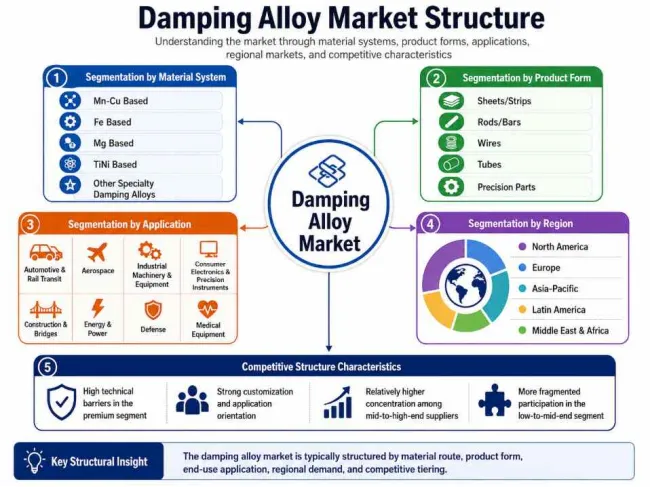
Figure from QYResearch: Global Damping Alloy Market Report 2026-2032.
In terms of market structure, the damping alloy sector is not merely a market for a single alloy grade or metallic material; rather, it constitutes a specialized niche within the functional materials domain, defined collectively by material systems, product forms, end-use applications, regional demand, and competitive tiers. Classified by material system, Mn-Cu-based, Fe-based, Mg-based, TiNi-based, and other specialized damping alloys each correspond to distinct damping mechanisms and application boundaries: Mn-Cu-based alloys are better suited for structural vibration reduction and scenarios requiring high internal friction; Fe-based alloys strike a balance between strength and processability; Mg-based alloys benefit from the broader trend toward lightweighting; and TiNi-based alloys—characterized by shape memory effects, superelasticity, and energy dissipation via phase transitions—are particularly well-suited for high-value-added functional components. In terms of product form, sheets/strips, rods, wires, tubes, and precision components serve distinct processing chains, catering to structural parts, fasteners, vibration-damping elements, and functional assemblies, respectively. The core value of damping alloys lies in their ability to absorb mechanical vibration energy—through mechanisms such as internal friction, phase boundary motion, twinning/dislocation movement, or phase transformation hysteresis—thereby reducing noise, mitigating shock, and enhancing structural stability. Relevant research further indicates that high-damping metallic materials possess significant engineering value in the fields of vibration control and structural reliability enhancement; moreover, materials such as shape memory alloys are increasingly deployed in highly demanding applications within the aerospace, automotive, and structural vibration control sectors.
Regarding the competitive and demand landscape, the damping alloy market exhibits distinct characteristics: it is driven by high-end applications, characterized by a divergence into specialized technical pathways, and defined by the critical role of customization capabilities in determining competitive advantage. Downstream applications span a wide array of sectors, including automotive and rail transit, aerospace, industrial machinery and equipment, consumer electronics and precision instruments, civil engineering and bridge construction, energy and electric power, defense and military industries, and medical devices. Among these, the high-end equipment, precision manufacturing, rail transit, and aerospace sectors—with their ever-increasing demands for vibration reduction, noise control, fatigue life longevity, structural stability, and lightweighting—serve as the primary drivers of industry growth. On a regional level, mature markets such as North America, Europe, and Japan tend to prioritize applications in high-end equipment, defense, aerospace, and precision instrumentation; conversely, the markets in China and the Asia-Pacific region exhibit a more diversified demand profile—encompassing rail transit, new energy equipment, industrial equipment upgrades, and consumer electronics—thereby presenting particularly significant potential for future incremental growth. In terms of the competitive landscape, the high-end market is characterized by high technological barriers; suppliers in this segment must possess capabilities in material formulation design, melt purity control, heat treatment processes, batch-to-batch consistency, performance testing, and end-customer validation. While supplier concentration is relatively high in the mid-to-high-end market, participants in the mid-to-low-end market remain highly fragmented. Overall, the core of competition within the damping alloy market is shifting from mere material supply toward a composite competitive model encompassing “material performance + process stability + application validation + delivery capabilities.”
Figure00002. Damping Alloy Industry Chain
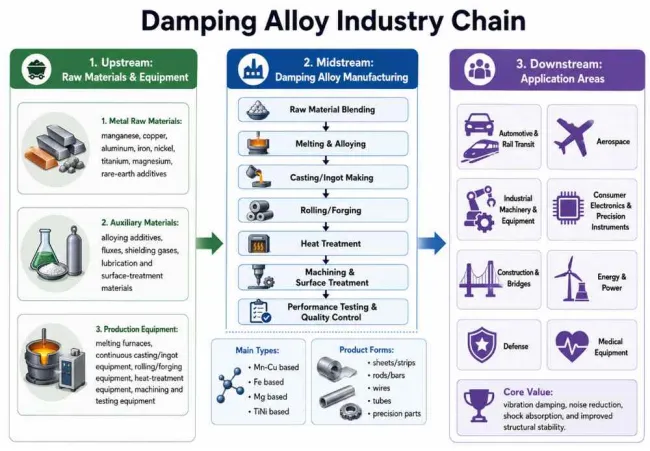
Figure from QYResearch: Global Damping Alloy Market Report 2026-2032.
From the perspective of the upstream supply chain, the primary inputs for damping alloys consist mainly of metallic raw materials, auxiliary materials, and specialized equipment. Among these, metallic elements—such as manganese, copper, aluminum, iron, nickel, titanium, magnesium, and rare earth additives—define the performance boundaries for various material routes; meanwhile, alloy additives, fluxes, protective gases, lubricants, and surface treatment agents influence melting purity, microstructural stability, and subsequent processing quality. The midstream segment represents the most concentrated area of value within the supply chain; its core processes encompass raw material proportioning, melting and alloying, casting/ingot formation, rolling/forging, heat treatment, machining and surface treatment, as well as performance testing and quality control. This implies that the competitiveness of damping alloy enterprises stems not merely from material formulations, but rather from a comprehensive capability encompassing “formulation design + microstructure control + heat treatment regimes + batch consistency + performance validation.” High-damping metallic materials typically dissipate mechanical vibration energy through mechanisms such as internal friction, phase transformations, dislocation motion, or interface motion, thereby achieving vibration reduction, noise abatement, and enhanced structural stability. Consequently, their manufacturing processes must place a paramount emphasis on material microstructure, defect control, and in-service reliability.
Regarding the interface between the midstream and downstream segments, damping alloys are produced in various product forms—including plates/strips, rods, wires, tubes, and precision components—each corresponding to distinct downstream processing methods and application scenarios. Plates and strips are best suited for structural vibration-damping components, while rods and tubes are frequently utilized for mechanical parts and connectors; wires and precision components, conversely, find greater application in functional parts, medical devices, precision instruments, and high-value-added equipment sectors. Downstream applications span a wide spectrum of fields, including automotive and rail transit, aerospace, industrial machinery and equipment, consumer electronics and precision instrumentation, civil engineering and bridge construction, energy and electric power, defense and military industries, and medical devices. The core value proposition of these materials lies in reducing vibration and noise, absorbing mechanical shock, extending component service life, and enhancing overall system stability. Functional materials—exemplified by shape memory alloys such as TiNi—possess inherent phase transformation hysteresis, superelasticity, and high damping capacity, thereby establishing a solid foundation for their application in demanding scenarios such as structural vibration control. Conversely, magnesium-based damping alloys, characterized by their low density and damping properties, align perfectly with the prevailing trend toward the development of lightweight equipment. Overall, the damping alloy industry chain is evolving from a traditional materials supply chain into an integrated chain encompassing “materials development, precision machining, application validation, and customized delivery.” Consequently, the focal point of competition in the high-end market will gradually shift toward the stability of material performance, end-use validation capabilities, and the capacity for customized services.
Figure00003. Working Principles of Damping Alloys Based on Different Technical Approaches
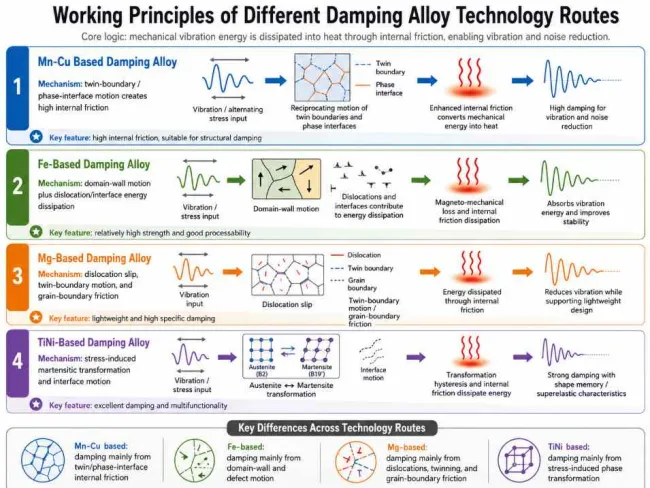
Figure from QYResearch: Global Damping Alloy Market Report 2026-2032.
From the perspective of technical approaches, the common operating principle of damping alloys involves converting external mechanical vibrations, shocks, or alternating stresses—input into the material—into dissipated thermal energy through the movement of internal microstructures, thereby achieving vibration reduction, noise attenuation, and enhanced structural stability. Mn-Cu-based damping alloys center on high internal friction generated by the reciprocating motion of twin boundaries and phase interfaces; they are well-suited for structural vibration damping, mechanical equipment, and applications requiring highly stable damping performance. Fe-based damping alloys, conversely, rely more heavily on the synergistic energy dissipation of magnetic domain wall motion, dislocations, and interfaces, offering a favorable balance among strength, processability, and engineering applicability. The primary advantages of Mg-based damping alloys lie in their low density and high specific damping capacity; their energy dissipation is typically associated with dislocation slip, twin boundary motion, and grain boundary friction, making them particularly suitable for lightweight structural components, transportation equipment, and weight-sensitive applications. TiNi-based damping alloys dissipate energy through stress-induced austenite-to-martensite phase transformations, phase boundary migration, and transformation hysteresis; simultaneously possessing shape memory and superelastic characteristics, they are better suited for high-value-added functional components, precision structures, and applications involving specialized operating conditions. Relevant research indicates that the damping performance of Mn-Cu alloys is closely correlated with the martensitic phase, twin boundaries, and heat treatment state, whereas the damping mechanism of Mg alloys is typically attributed to the synergistic interplay of internal factors such as dislocations, grain boundaries, and twins.
From the standpoint of industrialization, these distinct technical approaches fundamentally correspond to different market positioning and competitive barriers. The Mn-Cu-based and Fe-based approaches align more closely with engineering-grade structural damping materials, prioritizing stable damping performance, batch-to-batch consistency, mechanical properties, and cost controllability; they are applicable to vibration damping scenarios in industrial machinery, rail transit, civil engineering, and general equipment. The Mg-based approach benefits from the prevailing trend toward lightweighting, yet it necessitates striking a balance among high damping capacity, strength, corrosion resistance, and processing stability; consequently, it relies heavily on advanced alloy design and microstructure control capabilities. The TiNi-based approach features a higher level of technical sophistication and added value; its competitive barriers are concentrated in critical areas such as phase transformation temperature control, fatigue life, processing precision, functional stability, and end-product certification. Regarding Fe-based damping materials, published research indicates that iron-based alloys—such as Fe-Al—exhibit a magnetomechanical damping mechanism driven by the irreversible motion of magnetic domain walls. Conversely, the damping capabilities of TiNi and other shape memory materials are linked to martensitic phase transformations, phase hysteresis, and internal friction behaviors. Overall, the technological competition among damping alloys has shifted from a simple inquiry into “whether damping properties exist” to a comprehensive contest focused on “whether they can simultaneously satisfy requirements for damping, strength, lightweighting, reliability, and processability under specific operating conditions.”
At the policy level, although damping alloys do not typically appear as standalone consumer products, they are deeply intertwined with high-end new materials, high-performance alloys, advanced equipment, rail transit, aerospace, intelligent manufacturing, green manufacturing, and the revitalization of the industrial foundation. China’s “14th Five-Year Plan” explicitly calls for achieving breakthroughs in advanced materials—specifically citing high-end rare earth functional materials, high-quality special steels, high-performance alloys, and high-temperature alloys. Furthermore, the implementation plan for the “Three Improvements” in the raw materials industry emphasizes increasing product variety, enhancing quality, and building strong brands. Concurrently, policies promoting large-scale equipment renewal provide demand-side support for the upgrading of advanced machinery, industrial equipment, and infrastructure. As the nation enters the “15th Five-Year Plan” period, advanced materials, multi-scale manufacturing, the establishment of autonomous and controllable industrial chains, and the tackling of critical technological equipment challenges will remain key strategic priorities. Collectively, these policies are driving the evolution of damping alloys—transitioning them from laboratory-stage materials and small-batch applications toward full-scale engineering validation, domestic substitution, and integration into high-end equipment systems.
Relevant Policies in China
| Policy Direction | Timeframe | Main Content | Impact on the Damping Alloy Industry |
| Breakthroughs in High-End New Materials | 2021–2025 | Promote the development of advanced materials such as high-performance alloys, superalloys, and high-quality specialty steels | Enhances the strategic position of damping alloys as high-performance functional materials |
| “Three Products” Initiative for the Raw Materials Industry | Since 2022 | Promote product variety expansion, quality improvement, and brand building in the raw materials sector | Supports product series expansion, quality stabilization, and brand development for damping alloys |
| First-Batch Application of Key New Materials | Continuously promoted over the past five years | Encourage demonstration applications and insurance compensation mechanisms for key new materials | Helps high-end damping alloys enter equipment validation and small-batch application stages |
| Supportive Policies for High-End Equipment Manufacturing | Continuously promoted over the past five years | Support the development of aerospace, rail transit, intelligent manufacturing, and major technical equipment | Drives demand for vibration damping, noise reduction, shock absorption, and reliability-enhancing materials |
| Policies for New Energy Vehicles and Lightweight Materials | Continuously promoted over the past five years | Promote automotive lightweighting, higher efficiency, and material upgrading | Benefits Mg-based, high-specific-damping, and structure-function integrated materials |
| Large-Scale Equipment Renewal Policy | Since 2024 | Promote equipment renewal and upgrading in industrial, energy, transportation, and other sectors | Expands potential demand for high-reliability vibration-damping materials used in advanced equipment |
| High-Quality Development of Manufacturing | 2021–2025 and beyond | Emphasize industrial-chain resilience, core basic components, and foundational material capabilities | Creates broader opportunities for domestic substitution and engineering application of damping alloys |
| Advanced Materials Direction under the 15th Five-Year Plan | 2026–2030 | Focus on advanced materials, cross-scale manufacturing, industrial foundation upgrading, and major technical equipment | Expected to push damping alloys toward high-end grades, precision processing, and system-level applications |
| Green Manufacturing and Low-Carbon Transition | Past five years and the 15th Five-Year Plan period | Promote low-carbon, circular, and green supply-chain development in materials manufacturing | Encourages damping alloy producers to improve energy management, process efficiency, and environmental compliance |
The growth of the damping alloy industry is mainly driven by rising demand for vibration and noise control in high-end equipment, lightweighting trends, precision manufacturing upgrades, transportation and energy infrastructure development, defense and aerospace applications, and end users’ increasing emphasis on reliability and service life. Key challenges include limited large-scale application, long customer validation cycles, difficulty in maintaining process consistency, relatively high costs, an underdeveloped standards system, and insufficient application-side awareness. Overall, damping alloys are not a typical bulk materials market; rather, the industry follows a growth path of “technical validation → scenario introduction → stable small-batch supply → high-end customized expansion.” Short-term growth depends on the pace of adoption by high-end equipment manufacturers and key customers, while medium- to long-term growth depends on the maturity of alloy grade systems, processing technologies, testing standards, and application databases.
Industry Growth Trends, Barriers, and Challenges
| Type | Key Factor | Specific Manifestation | Impact on the Industry |
| Growth Driver | Rising demand for vibration and noise reduction in high-end equipment | Rail transit, aerospace, industrial machinery, and precision equipment require stronger vibration-control performance | Expands the application space for damping alloys in structural and functional components |
| Growth Driver | Lightweighting trend | New energy vehicles, aerospace, and portable equipment emphasize weight reduction and high specific damping | Promotes the development of Mg-based and other lightweight high-damping materials |
| Growth Driver | Precision manufacturing upgrade | Machine tools, instruments, robotics, and automation equipment require higher operational stability | Drives material demand in low-vibration, low-noise, and high-precision applications |
| Growth Driver | Domestic substitution of new materials | Greater emphasis on independent and controllable high-end alloy materials | Encourages Chinese companies to accelerate material R&D, engineering validation, and customer qualification |
| Growth Driver | Demand for multifunctional materials | Stronger demand for combined damping, shape memory, superelasticity, corrosion resistance, and high strength | Benefits high-value functional damping alloys such as TiNi-based materials |
| Growth Driver | Higher end-user reliability requirements | Customers focus on fatigue life, batch consistency, and long-term service stability | Enhances the technical premium of high-end damping alloys |
| Barrier/Challenge | Relatively small market size | Downstream applications are fragmented, and demand from a single customer is often limited | Makes it difficult for companies to rapidly release large-scale production capacity |
| Barrier/Challenge | Long customer validation cycle | High-end equipment requires material testing, working-condition validation, and certification processes | Extends the commercialization and adoption cycle |
| Barrier/Challenge | Difficulty in process stability | Melt purity, microstructure control, and heat treatment have significant effects on performance | Increases the difficulty of quality control and batch-to-batch consistency |
| Barrier/Challenge | Relatively high cost | High-performance alloying elements, precision processing, and testing costs are relatively high | Limits adoption in low-end and price-sensitive applications |
| Barrier/Challenge | Standards system still needs improvement | Different industries use different testing and evaluation criteria for damping performance | Affects cross-industry promotion and procurement decision-making |
| Barrier/Challenge | Insufficient end-user awareness | Some customers still prioritize structural strength and cost in material selection | Requires suppliers to strengthen application development and technical services |
Overall, the damping alloy industry is at a critical stage of transition from material-performance validation to broader engineering application. In the short term, market growth will be jointly driven by vibration and noise reduction in high-end equipment, lightweighting, reliability improvement, and precision manufacturing upgrades. In the medium to long term, as new material design methods, precision processing technologies, performance testing systems, and end-use certification mechanisms mature, damping alloys are expected to evolve further from traditional structural vibration-damping materials into key functional materials for advanced equipment. In terms of competition, the high-end market will place greater emphasis on material routes, process control, batch consistency, customer validation, and delivery capability, with supplier concentration likely to increase. Mid-to-low-end and general-purpose products will remain relatively fragmented, but their profit margins and technical barriers will be more limited. For companies, the key to future competitiveness will not be a single alloy grade, but an integrated system of material design capability + process stability + application validation capability + precision processing capability + reliable delivery capability. Damping alloys will continue to benefit from high-end manufacturing upgrades, equipment noise reduction, lightweighting, and reliability improvement, making them a niche segment in advanced metallic materials with both growth potential and technical barriers.
The report provides a detailed analysis of the market size, growth potential, and key trends for each segment. Through detailed analysis, industry players can identify profit opportunities, develop strategies for specific customer segments, and allocate resources effectively.
The Damping Alloy market is segmented as below:
By Company
Resonetics
Confluent Medical (NDC)
Johnson Matthey
Nippon Steel Corporation
Aperam
VACUUMSCHMELZE GmbH
Carpenter Technology
Daido Steel Co., Ltd
M&I Materials
Haynes International
VDM Metals GmbH
Materion Corporation
Thyssenkrupp AG
Guangzhou Xinyuan Hengye Power Transmission Device
TOSIUM
Segment by Type
Twin-type Alloys
Ferromagnetic Alloys
Dislocation-type Alloys
Multiple Phase Alloys
Segment by Application
Aerospace
Ship
Automobile
Machinery Manufacturing
Others
Each chapter of the report provides detailed information for readers to further understand the Damping Alloy market:
Chapter 1: Introduces the report scope of the Damping Alloy report, global total market size (valve, volume and price). This chapter also provides the market dynamics, latest developments of the market, the driving factors and restrictive factors of the market, the challenges and risks faced by manufacturers in the industry, and the analysis of relevant policies in the industry. (2021-2032)
Chapter 2: Detailed analysis of Damping Alloy manufacturers competitive landscape, price, sales and revenue market share, latest development plan, merger, and acquisition information, etc. (2021-2026)
Chapter 3: Provides the analysis of various Damping Alloy market segments by Type, covering the market size and development potential of each market segment, to help readers find the blue ocean market in different market segments. (2021-2032)
Chapter 4: Provides the analysis of various market segments by Application, covering the market size and development potential of each market segment, to help readers find the blue ocean market in different downstream markets.(2021-2032)
Chapter 5: Sales, revenue of Damping Alloy in regional level. It provides a quantitative analysis of the market size and development potential of each region and introduces the market development, future development prospects, market space, and market size of each country in the world..(2021-2032)
Chapter 6: Sales, revenue of Damping Alloy in country level. It provides sigmate data by Type, and by Application for each country/region.(2021-2032)
Chapter 7: Provides profiles of key players, introducing the basic situation of the main companies in the market in detail, including product sales, revenue, price, gross margin, product introduction, recent development, etc. (2021-2026)
Chapter 8: Analysis of industrial chain, including the upstream and downstream of the industry.
Chapter 9: Conclusion.
Benefits of purchasing QYResearch report:
Competitive Analysis: QYResearch provides in-depth Damping Alloy competitive analysis, including information on key company profiles, new entrants, acquisitions, mergers, large market shear, opportunities, and challenges. These analyses provide clients with a comprehensive understanding of market conditions and competitive dynamics, enabling them to develop effective market strategies and maintain their competitive edge.
Industry Analysis: QYResearch provides Damping Alloy comprehensive industry data and trend analysis, including raw material analysis, market application analysis, product type analysis, market demand analysis, market supply analysis, downstream market analysis, and supply chain analysis.
and trend analysis. These analyses help clients understand the direction of industry development and make informed business decisions.
Market Size: QYResearch provides Damping Alloy market size analysis, including capacity, production, sales, production value, price, cost, and profit analysis. This data helps clients understand market size and development potential, and is an important reference for business development.
Other relevant reports of QYResearch:
Global Damping Alloy Market Outlook, In‑Depth Analysis & Forecast to 2032
Global Damping Alloy Sales Market Report, Competitive Analysis and Regional Opportunities 2026-2032
Global Damping Alloy Market Research Report 2026
Global High Damping Alloy Market Outlook, In‑Depth Analysis & Forecast to 2032
Global High Damping Alloy Sales Market Report, Competitive Analysis and Regional Opportunities 2026-2032
High Damping Alloy- Global Market Share and Ranking, Overall Sales and Demand Forecast 2026-2032
Global High Damping Alloy Market Research Report 2026
Global Vibration Damping Alloy Market Outlook, In‑Depth Analysis & Forecast to 2032
Global Vibration Damping Alloy Sales Market Report, Competitive Analysis and Regional Opportunities 2026-2032
Vibration Damping Alloy- Global Market Share and Ranking, Overall Sales and Demand Forecast 2026-2032
Global Vibration Damping Alloy Market Research Report 2026
About Us:
QYResearch founded in California, USA in 2007, which is a leading global market research and consulting company. Our primary business include market research reports, custom reports, commissioned research, IPO consultancy, business plans, etc. With over 19 years of experience and a dedicated research team, we are well placed to provide useful information and data for your business, and we have established offices in 7 countries (include United States, Germany, Switzerland, Japan, Korea, China and India) and business partners in over 30 countries. We have provided industrial information services to more than 60,000 companies in over the world.
Contact Us:
If you have any queries regarding this report or if you would like further information, please contact us:
QY Research Inc.
Add: 17890 Castleton Street Suite 369 City of Industry CA 91748 United States
EN: https://www.qyresearch.com
Email: global@qyresearch.com
Tel: 001-626-842-1666(US)
JP: https://www.qyresearch.co.jp










